






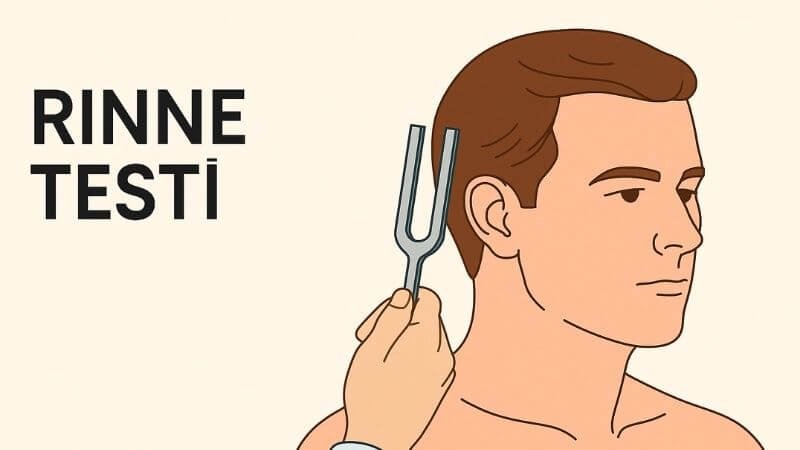
What is the Rinne Test? (Definition and
History)
The Rinne test is a bedside hearing examination
using a tuning fork to compare a patient’s air conduction (AC) hearing
to their bone conduction (BC) hearing in one ear at a time. It is
primarily used to quickly differentiate between conductive hearing loss
(problems of the external or middle ear) and sensorineural hearing loss
(inner ear or nerve issues). The test is named after Heinrich Adolf Rinne
(1819–1868), a German otologist who first described it in 1855. Along with
the Weber tuning fork test (named after Ernst Weber), Rinne’s test has stood
the test of time and is still routinely taught in medical education as part of
the clinical ear examination. In essence, a normal Rinne test indicates that
air conduction is more effective than bone conduction at transmitting sound to
the inner ear, which is the expected physiology of a healthy ear.
Historically
The Rinne test was one of several acoumétric tests
(tuning fork exams) used before the advent of audiometers. Over time, most
tuning fork tests fell out of favor, but the Rinne test (together with the
Weber test) remains a standard part of bedside examination. It is simple,
requires minimal equipment, and provides an immediate clue as to whether
hearing loss in an ear is likely conductive or sensorineural in
nature. This makes it useful in clinical settings as a preliminary screening
tool for unilateral hearing loss. However, it is important to note that
the Rinne test is a qualitative screening test and not a replacement for
formal audiometry.
How is the Rinne Test Performed?
(Step-by-Step Procedure)
The Rinne test is performed using a vibrating 512 Hz
tuning fork (the frequency traditionally recommended for hearing tests).
The patient should be seated in a quiet environment to avoid
interference. The examiner can follow these general steps:
- Prepare
the Tuning Fork: Strike the tuning fork on a firm
surface (e.g. knee or elbow) to start it vibrating at 512 Hz. Avoid
touching the tines after striking, and ensure the fork continues to
vibrate. (Lower-frequency forks like 128 Hz or 256 Hz are generally avoided
for Rinne testing, as they are used for vibration sensation exams and can
produce tactile vibrations rather than sound.)
- Test
Bone Conduction: Gently place the base of the vibrating
tuning fork on the mastoid process (the bony prominence just behind
the ear) of the ear being tested Instruct the patient to cover the
opposite ear with their hand (or the examiner can mask the opposite
ear by rubbing the tragus) to minimize sound input to the non-test ear.
Ask the patient to tell you when they no longer hear the sound
through the bone. Allow up to several seconds to ensure the patient
appreciates the sound before it fades.
- Test
Air Conduction: As soon as the patient indicates the
sound on the mastoid is gone, quickly move the still-vibrating tuning fork
and hold its tines about 1–2 cm in front of the ear canal (keeping
the fork parallel to the acoustic axis of the ear). The “U”-shaped
opening of the fork should face forward or be perpendicular to the ear
canal for optimal sound transmission. Ask the patient if they can hear the
tuning fork by air conduction (next to the ear) and to again indicate when
the sound is no longer heard. Normally, a person with good hearing will
continue to hear the sound through air conduction for several seconds
longer after they stop hearing it through bone conduction.
- Compare
Perceptions: In the classical method, the test
outcome is determined by whether the patient heard the tuning fork longer
by air or by bone. In some protocols (such as the British Society of
Audiology guidelines), the examiner may alternatively present the fork
first in front of the ear and then on the mastoid (for a fixed interval
each) and simply ask the patient which position sounded louder. In
either case, the examiner is comparing the effectiveness of air conduction
versus bone conduction in that ear. Repeat the test on the other ear as
needed, usually in conjunction with the Weber test for a complete
assessment.
During the procedure, it’s crucial to ensure the patient
understands the instructions and is responding to sound (not vibration sense).
The room should be quiet, and the examiner should stabilize the fork and
the patient’s head as needed (especially when pressing the fork on the
mastoid). Proper technique (including the fork’s orientation and consistent
distance from the ear) improves reliability. A well-performed Rinne test takes
only a minute or two and causes no discomfort to the patient (aside from the mild
pressure of the fork on the mastoid).
In What Situations is the Rinne Test Used?
Clinically, the Rinne test is used whenever a patient is
suspected to have hearing loss, particularly to determine if the loss is
due to a conductive problem in the outer or middle ear versus a sensorineural
problem in the inner ear or auditory nerve. It is most useful for patients
with unilateral hearing difficulties, where one ear’s hearing is worse
than the other. In such cases, the Rinne (together with the Weber test) can
quickly identify which ear is affected and what type of hearing loss is
present, guiding further management.
Some specific clinical scenarios where the Rinne test is
commonly applied include:
- Otitis
Media or Ear Canal Blockage: If a patient has a
history suggesting middle ear fluid (e.g. otitis media with effusion)
or cerumen impaction, a Rinne test can reveal a conductive hearing loss
(BC > AC) in the affected ear. This helps confirm that the hearing loss
is likely due to a blockage or middle ear issue (for example, wax buildup,
a middle ear infection, a perforated eardrum, or ossicular chain problem).
- Otosclerosis:
In cases of suspected otosclerosis (a fixation of the stapes bone in the
middle ear causing conductive loss), the Rinne test is often performed to
see if there is a negative Rinne (bone > air) suggesting
significant conductive hearing loss. In fact, Rinne testing may be used as
part of assessing eligibility for stapes surgery in otosclerosis
patients – a clear conductive deficit (Rinne negative) that would likely
be corrected by surgery.
- Sudden
Hearing Loss: In a patient with a sudden unilateral
hearing loss, a quick tuning fork examination (Weber and Rinne) can be
very informative. For example, a sudden sensorineural hearing loss
will typically show a Rinne positive (normal AC > BC) in the affected
ear but with Weber lateralizing to the better ear (indicating the affected
ear has inner ear loss). On the other hand, a sudden conductive loss (like
sudden middle ear effusion or ossicle disruption) would show Rinne
negative on that side. This differentiation is urgent, as true sudden
sensorineural loss requires prompt otolaryngology referral.
- General
Hearing Screening (Historical): In the past, Rinne and
Weber tests were taught for general hearing screening. For instance, older
clinical guidelines might mention using Weber/Rinne to assess adults with
hearing complaints in primary care. Modern practice, however, has shifted
to simpler screens (like the whispered voice test) for general
screening, because tuning fork tests are less sensitive for mild or
bilateral losses. Still, Rinne testing is appropriate as a bedside exam
whenever a focused assessment of conductive vs sensorineural hearing loss
is needed – such as during a neurologic exam or ENT examination for an
asymmetrical hearing loss.
Importantly, the Rinne test should not be used in
isolation. It is almost always accompanied by the Weber test to
provide a full picture of the hearing status. The combination of Weber and
Rinne results allows clinicians to interpret whether one ear has a conductive
loss, a sensorineural loss, or if hearing is symmetric. Any abnormal finding on
these tuning fork tests typically warrants formal audiometric testing for
confirmation and quantification.
Equipment Needed
The Rinne test requires minimal equipment: a tuning
fork (512 Hz) and nothing more. A 512 Hz fork is preferred because
frequencies in this range (512 Hz to 1024 Hz) lie within the speech frequency
spectrum and the tuning fork’s vibrations decay in a time frame useful for
testing. Lower-frequency forks (128 Hz or 256 Hz) are not ideal for Rinne’s
test – they produce longer vibration that can be felt through bone and soft
tissue (tactile vibration) and may give false responses. Higher frequencies
(1024 Hz or beyond) can be used, and some references mention 1024 Hz forks, but
these tones decay faster and can be harder for patients to hear unless the
environment is extremely quiet. Thus, the 512 Hz tuning fork strikes a
good balance and is the standard in most clinical examinations.
Aside from the tuning fork, the only other “equipment” is
a quiet setting. The examiner might also use their hand or fingers to
mask the non-test ear (by gently rubbing the tragus of the opposite ear,
creating a masking noise) especially if a false response due to the opposite
ear is suspected. Some examiners simply ask the patient to press a finger over
the opposite ear canal to diminish sound input to the other side. No electronic
devices or special tools are needed for the Rinne test, which is why it remains
feasible even in low-resource settings. In modern practice, the tuning fork is
often made of metal (usually steel or aluminum), and both materials have been
shown to work similarly for Rinne testing.
Expected Results and Interpretation of the
Rinne Test
After performing the Rinne test, the result is determined
by comparing the patient’s hearing by air conduction (near the ear canal)
versus bone conduction (mastoid bone):
- Normal
Hearing: In a person with normal hearing (or
symmetric sensorineural loss), air conduction (AC) is better than bone
conduction (BC). This means the patient can still hear the tuning fork
next to the ear after they can no longer hear it on the mastoid. In
practice, a normal-hearing individual will hear the tuning fork tone
approximately twice as long through air as through bone. This
outcome – AC > BC – is referred to as a “Rinne positive” result.
(It may seem counterintuitive that “positive” denotes a normal finding;
here “positive” simply means the test parameter – AC > BC – was met.)
Thus, Rinne positive = normal (or possibly sensorineural hearing
loss, see below).
- Conductive
Hearing Loss: If the patient cannot hear the
tuning fork at the ear after bone conduction, it indicates bone
conduction is greater than air conduction in that ear. This is an abnormal
result and is called a “Rinne negative” test. A Rinne negative
means that something is impairing the transmission of sound through the
air pathway (external or middle ear) before reaching the cochlea. In other
words, the ear has a conductive hearing loss – common causes
include cerumen impaction, middle-ear fluid (effusion), otitis media, perforated
eardrum, or otosclerosis, among others. With a true conductive loss of
significant degree, the patient hears better via bone because the sound
bypasses the blocked external/middle ear and directly stimulates the inner
ear. Rinne negative is always abnormal, and specifically points
toward a conductive pathology in that tested ear.
- Sensorineural
Hearing Loss: In a pure sensorineural hearing loss
(inner ear or nerve issue) affecting one ear, the Rinne test will still
show AC > BC in the affected ear – thus it will appear “Rinne
positive” (which mimics a normal ear). This is because in
sensorineural loss, both air and bone conduction routes are impaired to
a similar degree (the cochlea or nerve is less sensitive to sound by
either route). The patient will report hearing the fork by air after bone,
just like a normal ear, but they perceive the sound as much fainter or
shorter overall. In other words, AC is greater than BC, yet the total
duration they hear the tuning fork may be reduced compared to a normal
ear. Clinicians can sometimes detect this during the exam by noting that
the patient stops hearing the sound much sooner than expected, even though
AC lasted longer than BC. For example, the examiner (with normal hearing)
might still hear the fork when placed next to their own ear after the
patient stops hearing it – indicating the patient’s hearing (likely
sensorineural) is reduced. Because a sensorineural loss yields a “normal”
Rinne test, some sources call this situation a “false positive Rinne”
– the test is “positive” despite the presence of hearing impairment. It
underscores why Weber test and other assessments are needed: Rinne
alone cannot distinguish normal hearing from sensorineural loss – both
are Rinne positive.
To summarize the outcomes: a Rinne positive (AC >
BC) can mean either a normal ear or an ear with sensorineural loss; a Rinne
negative (BC > AC) specifically indicates a conductive hearing loss in
that ear. Because the nomenclature can be confusing, many clinicians prefer to
document the result in clear terms, for example: “Rinne test is abnormal
(negative) in the left ear, with bone conduction greater than air conduction”
rather than just saying “Rinne negative”.
In practice, interpreting the Rinne test is greatly aided
by also performing the Weber test (discussed below). For example, if the left
ear is Rinne negative (suggesting conductive loss), Weber should lateralize to
the left ear (sound perceived louder in the left) if it is truly a conductive
loss. If instead the left ear were actually a severe sensorineural loss, the
Rinne might appear negative due to a false effect (see next section), and Weber
would not lateralize to the left (it would go to the opposite ear).
Thus, the tandem of Weber and Rinne helps confirm the nature of the loss.
Advantages of the Rinne Test
- Quick
and Simple: The Rinne test can be performed at the
bedside in under a minute. It requires only a tuning fork and can be done
by a single examiner without elaborate setup. This makes it a convenient screening
or initial assessment tool for hearing loss in settings where formal
audiometry is not immediately available.
- No
Electrical Equipment Needed: Unlike audiometers or
other electronic hearing tests, tuning forks are inexpensive, portable,
and do not require power. This allows Rinne testing even in low-resource
or field settings and in any clinical environment (office, hospital ward,
emergency department, etc.).
- Differentiates
Hearing Loss Type: The primary advantage is that
Rinne (especially when combined with Weber) distinguishes conductive
vs. sensorineural hearing loss in a gross way. This is valuable
information: for instance, detecting a conductive loss might lead to
searching for treatable causes like wax or middle ear fluid, whereas a
sensorineural loss might prompt a referral for audiometry and neurological
evaluation.
- Part
of Neurological Exam: The Rinne (and Weber) tests are
part of the cranial nerve exam (assessing the acoustic nerve, CN VIII).
They allow a quick check of hearing during a general physical or neuro
exam and can alert the examiner to asymmetrical hearing deficits that
might need further workup.
- Patient
Engagement: Interestingly, performing tuning fork
tests can engage patients in their examination and education. It provides
an immediate demonstration that the patient can often appreciate (e.g.,
they realize they hear differently by bone vs air), which can help in
explaining their condition.
Limitations of the Rinne Test
Despite its usefulness, the Rinne test has several
important limitations:
- Not
a Quantitative Test: Rinne testing is qualitative
– it tells us the relative hearing by air and bone, but does not measure
the degree of hearing loss. A patient could have a moderate sensorineural
loss in both ears and still have a “normal” Rinne in each ear. The test
does not substitute for an audiogram, which quantitatively measures
hearing thresholds at various frequencies. Formal audiometry is
required to fully assess hearing loss severity and configuration
whenever a tuning fork test is abnormal or hearing loss is suspected.
- Insensitive
to Mild Conductive Loss: The Rinne test may be unable
to detect small air-bone gaps (mild conductive losses). Typically, a conductive
loss needs to be around 20–30 dB or greater for Rinne to turn negative.
If a patient has a slight conductive impairment (e.g. a minor eardrum
scarring or a small amount of fluid), they might still hear better by air
than bone, yielding a false-normal Rinne (“false positive”). Studies have
shown Rinne’s test reliably identifies conductive losses with air–bone
gaps of ~≥25 dB, but will miss smaller gaps.
- False
Results in Severe Loss: In cases of very
severe unilateral hearing loss (especially sensorineural), the Rinne
test result can be misleading due to the patient responding with the
opposite ear (see “false negatives” below). In other words, Rinne is not
reliable if the test ear has a profound hearing loss, because the test
can be confounded by cross-hearing to the other ear. Such cases require
careful interpretation with Weber test or masking techniques.
- Bilateral
Losses Limit Usefulness: The Rinne test is most
informative when comparing a poorer ear to a better ear. If a patient has bilateral,
symmetrical hearing loss (whether conductive or sensorineural), each
ear might yield the same Rinne result, potentially appearing “normal” if
both have the same type of loss. For example, bilateral symmetric
sensorineural loss (like age-related hearing loss) will show Rinne positive
in both ears (AC > BC), even though the patient does have significant
hearing impairment. Conversely, bilateral identical conductive loss could
show Rinne negative in both ears. In either scenario, Weber test might be
midline, and the tuning fork exams could be falsely reassuring or simply
confirm the losses are of the same type in both ears. Thus, tuning forks
are not useful for screening bilateral hearing loss in many cases –
audiometry would be needed to detect and assess such losses.
- User
Technique and Variability: The accuracy of the
Rinne test depends on proper technique and patient cooperation.
Studies have found significant variability in how practitioners perform
the test (e.g. differences in whether bone is tested before air, how far
the fork is held from the ear, orientation of the tines, etc.). These
differences generally do not change the fundamental outcome (AC vs BC
comparison), but poor technique – such as not holding the fork close
enough, or allowing the fork to stop vibrating – can lead to incorrect results.
The orientation of the tuning fork matters: the tines should be
parallel to the ear canal, not pointing into it, to maximize sound
transmission. If the test is done hastily or the instructions are unclear
to the patient, the results may be unreliable. Consistency and proper
training are important to mitigate this limitation.
- Not
a General Screening Tool: Because of the above
issues (misses mild losses, needs patient cooperation, etc.), the Rinne
and Weber are not considered good general screening tests for hearing
impairment in asymptomatic populations. For example, the whispered
voice test or questionnaires are recommended for initial screening in
primary care, with tuning fork tests reserved for diagnostic distinction
of loss type rather than detection of any loss.
In summary, the Rinne test is a useful quick assessment,
but any abnormal or inconclusive Rinne test should be followed by
comprehensive audiological evaluation. Even its role in screening is now
debated, given the availability of easy alternatives and audiometry. Clinicians
must be aware of its limitations to avoid misinterpretation.
Pitfalls: False-Positive and False-Negative
Rinne Test Results
Two classic pitfalls in Rinne interpretation are false
negatives and false positives (in the context of the test’s ability
to detect conductive loss):
- False-Negative
Rinne: This refers to a situation where the
test appears Rinne negative (BC > AC) even though the tested ear
does not actually have a conductive loss. The most important
example is in a patient with a total sensorineural hearing loss
in one ear (a “dead” ear). In this case, when the tuning fork is
placed on the mastoid of the deaf ear, the sound may transmit through the
skull to the opposite (good) ear’s cochlea, and the patient, not
realizing which ear heard it, will indicate they heard the sound. Then,
when the fork is moved next to the deaf ear’s canal, the sound is not
heard (because that ear is essentially non-functional and the sound is not
loud enough to be heard by the other ear via air conduction). The patient
thus reports “bone conduction” (which in fact was heard by the other ear)
was better than air, leading the examiner to think Rinne is negative –
incorrectly suggesting a conductive loss in the deaf ear. In reality, this
is a false finding due to cross-hearing. The Weber test will
usually give the clue: in a unilateral total sensorineural loss, Weber
will lateralize to the good ear, indicating the bad ear is not
perceiving sound at all, which contradicts a true conductive loss
scenario. Another clue is to ask the patient which ear heard the
sound during the mastoid placement; often they will localize it to the
opposite side in a false-negative scenario. To avoid false negatives, some
examiners use masking noise in the opposite ear (like rubbing the tragus
or using white noise) while testing bone conduction, though this is an
inexact technique. The definitive solution if a false-negative Rinne is
suspected is to proceed with formal audiometry with proper masking.
- False-Positive
Rinne: This term is a bit confusing, as “Rinne
positive” normally means a healthy or sensorineural ear. A “false
positive” in this context means the Rinne test is positive (AC > BC)
even though a conductive loss is actually present. This can happen if
the conductive loss is small or subtle. Because a normal ear has a
fairly large advantage of AC over BC, a mild conductive impairment (say
10–15 dB air-bone gap) might not reverse the relationship – the patient
might still report AC slightly better than BC, yielding a “positive” Rinne
despite an underlying conductive pathology. In other words, the Rinne test
can miss a mild conductive hearing loss, as noted earlier. Some
sources also consider that in cases of bilateral conductive loss,
each ear might falsely appear “positive” if the losses are symmetric and
the patient still hears by air longer than bone (albeit both diminished).
Essentially, a false-positive Rinne is a false sense of normal result.
The pitfall here is that the examiner might be misled into thinking hearing
is normal (or purely sensorineural) when there is in fact a small conductive
deficit. The sensitivity of the Rinne test for conductive losses is
limited – one report estimated Rinne (and Weber together) have a
sensitivity around 77% and specificity ~85% for detecting hearing loss in
general, with most misses being mild conductive cases. The takeaway is that
a “Rinne positive” should be interpreted in context: if clinical suspicion
for conductive pathology remains (e.g., the patient has otoscopic findings
of middle ear fluid or a history of conductive symptoms), further testing
is warranted even if the bedside Rinne is “positive/normal.”
In summary, false negatives occur with very deaf ears
(due to sound heard by the other ear), and false positives occur with
slight conductive losses that the Rinne test can’t detect. Using the Weber
test alongside Rinne, and being aware of the patient’s overall clinical
picture, helps to identify these pitfalls. Whenever results are inconsistent
(for example, Rinne suggests one thing but Weber or history suggests another),
one should verify with a fully masked audiogram rather than relying on
the tuning fork alone.
Clinical Significance in Special Populations
Elderly Patients: In
older adults, hearing loss is often bilateral and sensorineural (presbycusis).
The Rinne test in such cases will usually be positive in both ears
(since presbycusis affects inner ear function equally), giving an appearance of
“normal” Rinne despite the patient having reduced hearing. This means that
tuning fork tests can underestimate hearing impairment in the elderly,
especially if losses are symmetric. For instance, an 80-year-old with equal
moderate sensorineural loss in both ears will have Rinne AC > BC on each
side and Weber centered – a pattern indistinguishable from a normal-hearing
person via tuning forks. Therefore, guidelines like the JAMA Rational
Clinical Examination suggest using the whispered voice test or direct
inquiry for screening hearing in the elderly, and not relying on
Weber/Rinne for general screening. However, if an older patient has an asymmetrical
loss (one ear worse), Rinne and Weber can still pinpoint the affected ear and
type of loss. Also, conductive issues do occur in the elderly (e.g. cerumen
impaction or otosclerosis), and Rinne remains useful to detect those when
suspected. The key is to remember a normal Rinne in an older person does not
guarantee normal hearing – it only indicates no significant conductive
component. Any complaints of hearing difficulty in the elderly should prompt
formal audiometry regardless of Rinne test results.
Pediatric Patients: In
children, especially older, cooperative children, the Rinne and Weber
tests can be valuable tools to assess hearing loss in a clinical setting. The
most common hearing issue in children is conductive loss due to otitis
media with effusion (“glue ear”). A Rinne test can help confirm a conductive
loss in a child who is old enough to understand and respond reliably – you
would expect a Rinne negative (BC > AC) in an ear with significant
middle-ear effusion or chronic otitis. However, there are special
considerations: young children may have trouble understanding the test
instructions or communicating which sound is louder. It’s often helpful to explain
the procedure in simple terms and even demonstrate it on a parent or on
yourself first. Children might respond better by pointing to their ear or
saying “front” vs “back” to indicate where the sound was louder, rather than
the abstract concept of air vs bone conduction. For very young or
developmentally delayed children, formal tuning fork tests are not feasible –
instead, objective tests like otoacoustic emissions (OAE) or auditory
brainstem response (ABR), or behavioral audiometry in a sound booth, are
used for hearing assessment. Another point is that bilateral hearing loss in
children (which could be sensorineural or due to bilateral otitis media)
should be assessed with comprehensive audiometry; tuning forks won’t reliably
quantify or sometimes even detect the issue if symmetric. In summary, Rinne is
useful in a child who can cooperate and has one ear worse than the other (e.g.,
unilateral conductive loss), but it is not a stand-alone test in pediatrics.
Early identification of hearing loss in children is critical for language
development, so any abnormal or inconclusive tuning fork test in a child
warrants prompt referral for a full audiologic evaluation.
Unilateral vs. Bilateral Loss: The
Rinne test is inherently a one-ear test – it compares two pathways (AC
vs BC) in the same ear. Its highest utility is in unilateral or
asymmetric hearing losses. If a patient reports one ear is better than the
other, Rinne will identify if the poorer ear has a conductive deficit (Rinne
negative) or not (Rinne positive, implying either normal or sensorineural loss
in that ear). Meanwhile, the better ear usually has a normal Rinne (unless it
too has issues). In unilateral hearing loss cases, the combination of
Rinne and Weber gives a clear picture: for example, if the left ear is Rinne
negative and Weber lateralizes to the left, it’s a left conductive loss; if the
left ear is Rinne positive but Weber lateralizes to the right (good ear), it’s
likely a left sensorineural loss. In bilateral losses, as discussed,
Rinne might be positive in both (if both losses are sensorineural or mild
conductives) or negative in both (if both ears have large conductive
components). Such patterns require careful interpretation; bilateral Rinne
negatives suggest significant conductive impairment in both ears (which is
possible in bilateral otosclerosis or chronic otitis media), whereas bilateral
Rinne positives with evident hearing difficulty suggest bilateral sensorineural
loss. In either scenario, Weber’s test in bilateral equal losses will be
midline (non-lateralizing) and tuning fork tests won’t tell the degree of loss.
Therefore, bilateral hearing loss of any significance should be formally tested
– tuning forks can at most confirm whether a conductive component exists or not
in each ear, but they can’t assess severity.
Other Considerations: In
patients with certain conditions like a unilateral tinnitus or hyperacusis,
performing tuning fork tests can be tricky as the tone may aggravate symptoms
or be perceived differently. In patients who have had middle ear surgery (e.g.,
ossicular chain reconstruction), results might be atypical (a patient with a
prosthesis might still show a slight negative Rinne if the reconstruction isn’t
perfect). Additionally, for patients with mixed hearing loss (both
conductive and sensorineural components in the same ear), the Rinne test will
usually be negative if the conductive component is sizeable, since that
dominates the AC vs BC comparison. However, mixed losses can be hard to
interpret on tuning fork tests alone; audiometry is needed to tease out the
air-bone gap in such cases.
In all special populations, the Rinne test provides a
piece of the puzzle. Clinicians must correlate it with the history (e.g., an
elderly patient with difficulty in crowds likely has presbycusis even if Rinne
is normal, whereas a child with a history of ear infections and Rinne negative
likely has a treatable conductive issue) and with other examination findings
(like otoscopy and Weber test) to arrive at the correct interpretation.
Comparison with Other Tuning Fork Tests
(Weber, Schwabach, etc.)
The Rinne test is usually performed together with the Weber
test, as the two are complementary. Additionally, there are other classic
tuning fork tests (like the Weber, Schwabach, Bing, and Gellé
tests), though the latter ones are now of mostly historical or academic
interest. Here’s how Rinne compares and contrasts with these tests:
- Weber
Test: In the Weber test, the vibrating tuning fork (often
the same 512 Hz fork) is placed on the midline of the skull – commonly on
the forehead or teeth – and the patient is asked where they hear the sound
(left, right, or center). The Weber test essentially checks lateralization
of sound. In normal hearing or symmetric loss, the patient hears
the sound in the middle (equally in both ears). In unilateral
conductive hearing loss, sound lateralizes to the affected (bad)
ear (this is because the affected ear’s cochlea gets relatively more input
via bone due to lack of ambient noise via air and possibly the occlusion
effect). In unilateral sensorineural hearing loss, sound
lateralizes to the better ear (the bad ear’s inner ear cannot
perceive the sound as well). For example, if a patient has left conductive
hearing loss, Weber will be louder in the left ear; if they have left
sensorineural loss, Weber will be louder in the right ear. Weber test
alone cannot distinguish which type of loss, but combined with Rinne it can.
A quick combined interpretation: if Weber lateralizes to one ear and that
ear has a negative Rinne, it’s conductive loss in that ear; if
Weber lateralizes to one ear and that ear’s Rinne is normal (positive),
then the opposite ear likely has sensorineural loss. Weber is sensitive
even to small differences (it can lateralize with as little as a 5 dB
difference between ears), making it a very useful adjunct to Rinne.
Together, Weber and Rinne have moderate accuracy – one systematic review
found that an abnormal Weber has a positive likelihood ratio ~1.6 for
hearing loss and an abnormal Rinne can have LR up to 2.7–62 for diagnosing
conductive loss depending on severity. However, as noted, they are not
perfect and should be used as part of a battery of tests rather than
standalone.
- Schwabach
Test: The Schwabach test is a less commonly performed
tuning fork test that compares the patient’s bone conduction hearing to
that of the examiner (who is assumed to have normal hearing). It is
essentially an absolute bone conduction duration test. To perform
it, a tuning fork is placed on the patient’s mastoid, and when the patient
can no longer hear it, the examiner quickly places the fork on their own
mastoid to see if they can still hear it. If the patient’s bone
conduction duration is shorter than the examiner’s, it suggests a sensorineural
hearing loss (the patient’s inner ear cannot hear as long as normal).
If the patient hears the tuning fork longer than the examiner does, it
suggests a conductive hearing loss (the patient’s inner ear is
basically normal, and the apparent prolonged hearing via bone is because
their external/middle ear issue prevented them from hearing external
noises, and/or the occlusion effect in a conductive loss makes bone
conduction seem louder). In summary: Schwabach shortened = sensorineural
loss; Schwabach prolonged = conductive loss. While historically
part of ENT exams, the Schwabach test requires the examiner to have normal
hearing and is somewhat subjective. It has largely been replaced by formal
audiometry. It’s rarely taught in detail except in academic settings now,
but knowing its principle can reinforce understanding: a conductive loss
patient often has near-normal inner ear function (hence good bone hearing,
sometimes even seemingly “better than normal”), while a sensorineural loss
patient has reduced bone hearing compared to normal.
- Bing
Test: The Bing test is another old tuning fork test that
uses the principle of the occlusion effect. The fork is placed on
the mastoid while the examiner alternatively opens and closes the
patient’s ear canal (e.g., by pressing on the tragus). In normal or
sensorineural ears, closing the ear canal increases the perceived loudness
of the bone-conducted sound (occlusion effect), so the sound seems to get
louder when the ear is occluded. In a conductive hearing loss ear, this
occlusion effect is absent (because the ear is already effectively
occluded by the pathology), so the patient notices no change in loudness
with ear canal closure. A positive Bing (sound louder with ear
closed) is normal/sensorineural; a negative Bing (no difference)
indicates conductive loss. The Bing test is not commonly performed
clinically nowadays, as it provides similar info to Rinne, but you may see
it mentioned in older literature or asked about in exams.
- Gellé
Test: This is a more specialized historical test for
stapes fixation (otosclerosis). A tuning fork is placed on the mastoid
while the examiner increases pressure in the external ear canal (using a
rubber bulb or Siegle’s otoscope to deliver pressure). In a normal ear,
increasing pressure on the stapes via the eardrum will dampen bone
conduction hearing (the sound diminishes) – a negative result. If the
stapes is fixed (otosclerosis), the pressure change does not affect the
bone-conducted sound – a positive Gellé sign (meaning likely
otosclerosis). This test is largely obsolete now that we have impedance
audiometry and other diagnostic tools for otosclerosis, but it’s a neat
historical footnote that tuning forks were once used even to detect stapes
mobility.
In practice today, when someone mentions tuning fork
tests, they almost always mean Rinne and Weber. These two in conjunction
are sufficient for bedside differentiation of hearing loss types in most
scenarios. Schwabach, Bing, and others are of academic interest and rarely
performed. Modern otolaryngology relies on audiograms, tympanometry, and more objective
tests for detailed hearing assessment, but Rinne and Weber remain in use for
quick evaluations and teaching because they illustrate fundamental principles
of hearing physiology.
Variations in Technique and Interpretation
Across Regions
While the concept of the Rinne test is universal, there
are minor variations in how it is taught and performed in different
countries and by different examiners. A 2019 review highlighted a “high level
of variability” in Rinne test instructions across sources. For instance, most
medical textbooks and instructors advocate the classical technique: bone
conduction first, then air conduction, as described above. However, some
guidelines (like the UK’s British Society of Audiology 2022 procedure)
recommend starting with air conduction and then bone, asking the patient which
was louder. The end result tested (AC vs BC comparison) is the same, but the
approach can differ. Importantly, a study found these procedural differences
(which ear first, distance of fork, etc.) did not significantly impact the
diagnostic reliability of the Rinne test, as long as the fundamental
question of “is sound louder by air or bone?” is answered.
Differences can also be seen in terminology. In
some regions, instructors avoid using the terms “positive” and “negative” to
prevent confusion; instead, they report Rinne results as “normal (AC >
BC)” or “abnormal (BC > AC)”. In French literature, a Rinne test
where AC > BC is sometimes called “Rinne positif ou nul,” implying either
positive or no conductive loss, whereas AC < BC is “Rinne négatif”
indicating conductive loss. In Spanish, one simply says “Rinne positivo” if the
patient hears better by air, typical of normal or sensorineural loss, and
“Rinne negativo” if bone is heard better, typical of conductive loss. The
concept is consistent, but phrasing may vary slightly by language and
tradition.
Frequency of the tuning fork
used might vary as well. As noted, 512 Hz is the standard in many countries
(U.S., U.K., etc.). Some European sources mention using a battery of
frequencies (256, 512, 1024 Hz) for tuning fork exams, or specifically using
256 Hz for Rinne in a quiet setting. The general consensus is to use 512 Hz for
Rinne and Weber because it is more easily heard and less likely to be felt, but
one might see variation based on what tuning forks are available or traditional
teaching. In practice, if only a 256 Hz fork is on hand, an examiner might
still perform Rinne with it, keeping in mind it could produce tactile
vibrations at high intensity.
Another variation is masking the opposite ear.
Some examiners routinely mask the non-test ear (by rubbing the tragus or having
the patient hum or plug the ear) during Rinne to avoid any chance of the other
ear contributing, especially if they suspect one ear is dead. Others skip
masking unless the scenario (or Weber test) indicates its necessity, since
routine masking with a tuning fork can be awkward and not entirely effective.
There isn’t a single global standard on this; it’s a matter of examiner preference
and clinical context.
In terms of interpretation standards, there is
broad agreement internationally on what constitutes a normal vs abnormal Rinne.
However, there have been regional differences in how confidently clinicians
rely on the Rinne test. For example, some older European texts describe that a
Rinne test can only detect a conductive loss if the air-bone gap is >15–20
dB, whereas others put that cutoff at ~30 dB. These are not contradictions per
se, but reflect different interpretations of studies. Modern evidence-based reviews
(including contributions from various countries) have tried to quantify this:
one systematic review (Kelly et al. 2018 in Otolaryngology–Head & Neck
Surgery) looked at diagnostic accuracy of tuning fork tests across studies.
Generally, clinicians worldwide understand that mild conductive losses may be
missed and that Rinne is more specific than sensitive (it’s very good at
confirming a conductive loss when Rinne is clearly negative, but a positive
Rinne doesn’t entirely rule out a minor conductive component).
Different countries’ clinical guidelines also
mention tuning fork tests to varying extents. The UK’s NICE guidance on hearing
loss suggests using Weber and Rinne in assessment of adult hearing loss in
primary care to help differentiate causes. The American Academy of Family
Physicians (AAFP) in its practice articles notes that tuning forks are an
option but tends to emphasize audiometry or whisper tests for screening. In
low-resource countries, where audiometry may not be readily available in every
clinic, tuning fork tests (Rinne/Weber) might still play a frontline role in
the hands of general practitioners or ENT doctors to decide on referrals. Thus,
while the test itself is the same, the degree of reliance on it can vary: in
some places it’s a routine part of any ENT exam; in others, it’s done more for
teaching or when audiometry is not immediately at hand.
One interesting modern variation is the development of smartphone
applications to replicate tuning fork tests. Researchers in different
countries have tested using smartphones’ vibration function or audio outputs to
perform a “digital Rinne test.” For example, a smartphone-based Rinne test
was validated in a clinical study as being able to detect an air-bone gap of
≥25 dB at 512 Hz with about 98% agreement to the traditional tuning fork
Rinne. This involves using a phone’s vibrate setting on the mastoid and then a
tone played near the ear, leveraging ubiquitous technology to expand access to
hearing tests. Such innovations may mean that in the future, the concept of
Rinne’s test lives on via apps even if physical tuning forks are not at hand.
In summary, the Rinne test’s core principle is consistent
globally, but there are minor regional and methodological variations in
how it’s conducted and taught. Clinicians should be aware of these, especially
if reading international literature. Regardless of technique differences, the
critical commonality (as one study concluded) is ensuring the patient is able
to compare air and bone conduction – that determines the outcome.
Modern Alternatives and the Rinne Test’s Role
Today
The Rinne test is over 150 years old, and in the modern
era of audiology, it has largely been supplemented or even supplanted by more
quantitative tests. Pure-tone audiometry (with air and bone conduction
testing under headphones and oscillators) is the gold standard for evaluating
hearing loss. Audiometry provides precise measurements of air–bone gaps and can
detect even mild hearing losses at various frequencies, which no tuning fork
test can quantify. Thus, if available, audiometry will always be used to
confirm and detail any hearing loss suggested by a Rinne test. In fact, current
practice is often to go straight to audiometry for patient complaints of
hearing loss, especially in developed healthcare settings.
However, the Rinne (and Weber) tests still hold value as
quick diagnostic tools at the point of care. They are particularly
useful in situations like emergency or urgent evaluations (e.g., a sudden
hearing loss, or trauma to the ear) where one needs an immediate sense of
whether the issue might be conductive (perhaps a hemotympanum or ossicular
dislocation) versus sensorineural (inner ear concussion). They are also useful
as part of the office physical exam for ENT physicians or neurologists as an
on-the-spot check. Because tuning fork tests are low-cost and portable, they
remain relevant in resource-limited settings or on global health
missions, where an audiometer might not be accessible. A correctly interpreted
Rinne and Weber can triage a patient – for example, deciding if a unilateral
loss might just be wax (conductive, Rinne negative) treatable in clinic, versus
a sudden sensorineural loss (Rinne positive, Weber to opposite ear) requiring
urgent referral.
Modern alternatives and adjuncts include:
- Whispered
Voice and Smartphone Apps: As mentioned, simple
tests like the whispered voice test have surprisingly good
sensitivity for general hearing screening and are recommended by some
experts for primary care screening of elderly patients. Also, mobile
apps and devices are emerging. Aside from smartphone Rinne tests with
vibration, there are apps that conduct basic audiometry or hearing check.
These apps can play tones of different frequencies and record if the
patient hears them, essentially performing a rudimentary hearing test.
While not as controlled as a calibrated audiometer, studies have found
smartphone-based hearing tests can reasonably detect moderate hearing
losses and serve as a viable alternative in low-resource settings.
Some apps specifically have a “Weber test” function using vibrations on
the forehead, and presumably Rinne functions as well. These technological
alternatives are modern twists but still rooted in the same principles as
Rinne and Weber.
- Tympanometry
and Acoustic Reflex Testing: For diagnosing
conductive issues, tympanometry is a modern tool that measures
eardrum mobility and middle ear pressure. It doesn’t directly compare AC
vs BC, but it provides objective evidence of a conductive problem (like
fluid or ossicular fixation). In an updated practice, if a Rinne test
suggests a conductive loss, a tympanogram can quickly confirm middle ear
dysfunction. This is something Rinne’s 19th-century inventors didn’t have,
but now it’s commonly used alongside audiometry.
- Otoacoustic
Emissions (OAE): These are used mainly for newborn
hearing screening and to detect cochlear (outer hair cell) function. They
don’t replace Rinne, since they don’t compare AC/BC, but they are a modern
method to detect inner ear deficits (sensorineural loss) even when patient
feedback is unavailable. In an infant, one obviously cannot do a Rinne
test – but an OAE screen can be done. Thus, OAE and ABR (Auditory
Brainstem Response) tests are the modern analogs for populations that
can’t do behavioral tests.
Given these alternatives, one might ask: Is the Rinne
test still necessary to teach and use? Many medical schools continue to
teach it (along with Weber) as part of physical diagnosis, because it
illustrates important concepts of hearing and allows a hands-on assessment
skill. A publication in 2019 questioned the necessity of these tests in the age
of audiometry, noting the variability in teaching and that ultimately
audiometry often replaces them. Nevertheless, as of 2025, Rinne and Weber
remain in clinical use as quick screening maneuvers. They cost nothing, can be
done anywhere, and when interpreted correctly, they provide immediate
directional information (conductive vs sensorineural) that can guide further
testing or management.
In conclusion, the Rinne test is a time-honored
clinical tool for evaluating hearing, particularly useful for identifying
conductive hearing loss in one ear. It has its strengths (simplicity and
ability to differentiate types of loss) and its limitations (inability
to quantify loss and potential for false results). Across different countries
and eras, it has been adapted and studied, yet its core principle remains the
comparison of air and bone conduction hearing. Modern medicine has developed
more sophisticated hearing tests and even digital versions of Rinne’s test, but
the traditional tuning fork exam continues to have a place in otolaryngology
and audiology as a quick, informative bedside test. Every health professional
in otolaryngology or primary care should be familiar with the Rinne test, both
for its historical importance and its ongoing clinical utility in assessing
patients with hearing complaints.
Sources: Rinne test information from clinical guides and textbooks; procedure and interpretation details from StatPearls and BSA guidelines; advantages/limitations from ENT literature; false-result concepts from J.Otolaryngology and StatPearls; pediatric and special population considerations from DFTB (2021) and JAMA (2006); comparison with other tests from Oxford Medical Education and Britannica; international and modern perspective from research studies and guidelines.
Leave a comment